Sep 2026,
Iris in Lean
(with many others)
Abstract:
The Iris framework for concurrent separation logic has been widely used for program verification research.
An important factor contributing to the framework's adoption is its high-quality mechanization in Rocq.
This mechanization uses a number of Rocq features in sophisticated ways, including a carefully constructed algebraic hierarchy for modeling separation logic resources, and a proof mode for embedded separation logic proofs, which combines custom Ltac with extensible typeclasses.
The library has been developed for over a decade with dozens of contributors, with an emphasis on modularity and maintainability.
We explore how Lean features like flexible metaprogramming and quotient types can simplify the design and usage of Iris.
Using these features, we provide a novel implementation of the Iris proof mode with improved performance, simplify the handling of equivalences through quotient types, build a variant of Diaframe proof automation, and provide convenience features like automatic construction of Iris fixed points.
Building on Lean lets us integrate with the extensive Mathlib library, allowing us to re-use results from this library for program verification tasks that have heavy mathematical dependencies, as we demonstrate with an application to probabilistic program verification.
Jul 2026,
Mosaic: From Language Fragments to Program Logics
(with K. Kraßnitzer, M. Sammler
and R. Jung)
Abstract:
Program logics have proven effective at verifying programs by leveraging modular reasoning.
However, the process of building program logics is itself usually not modular:
Even though many languages share common features like integers, booleans, heaps, or concurrency, program logics for different languages are usually defined and proven sound independently.
In this paper, we present Mosaic, a new framework for building program logics by composition.
Mosaic views a programming language as a sum of fragments.
Each fragment covers a particular feature or aspect of a language, supplying syntax, semantics, program logic, and soundness of said logic.
These fragments can be freely combined to obtain a programming language with an accompanying program logic.
When realized in a proof assistant, each fragment furthermore comes with a set of tactics that are then automatically available in any language that includes the fragment.
We provide a library of 27 fragments, including fragments for higher-order heaps, concurrency, and atomic blocks.
Particularly noteworthy is our fragment for prophecy variables which comes with a reusable, language-generic erasure theorem.
To demonstrate the scalability of our approach, we use it to recreate the HeapLang and λRust languages from prior work.
We show that our composed versions are usable in practice
by porting several large proof examples with minimal changes.
All of our development is formalized using Rocq and Iris.
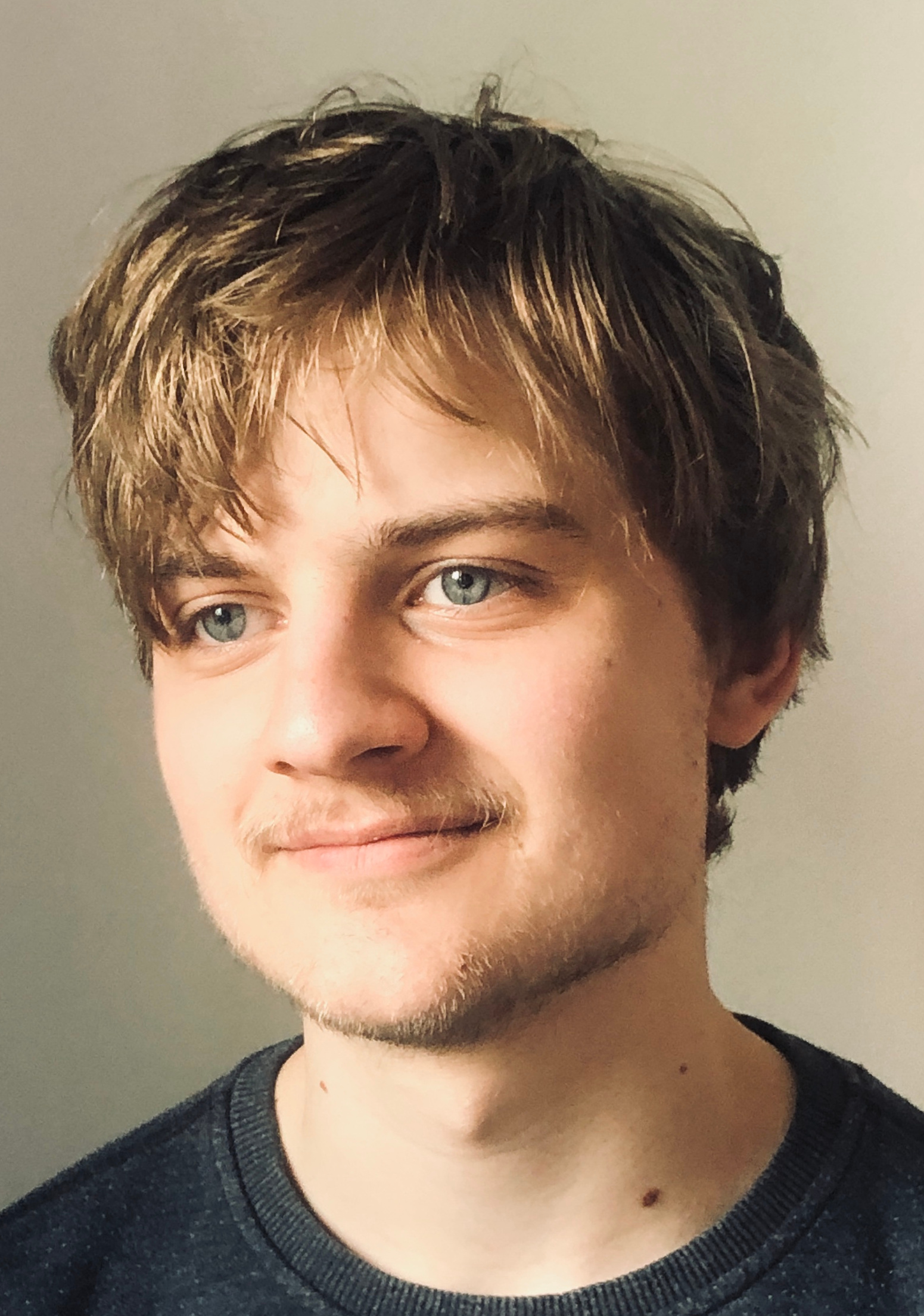 I'm a doctoral student at ETH Zürich in Computer Science.
My advisor is Ralf Jung and I work on logics for reasoning about programs.
Previously, I completed a MSc in pure mathematics
at the University of Copenhagen
and then taught CS there.
Here, you can find my research in math and CS.
.
GPG.
I'm a doctoral student at ETH Zürich in Computer Science.
My advisor is Ralf Jung and I work on logics for reasoning about programs.
Previously, I completed a MSc in pure mathematics
at the University of Copenhagen
and then taught CS there.
Here, you can find my research in math and CS.
.
GPG.